
APRC Home Care

Physiotherapy at Home

Physiotherapy at Home for neck pain
Physiotherapy

Is Physiotherapy at Home Worth It for Neck Pain?

A stiff, aching neck has a way of narrowing an entire day — turning to check a blind spot while driving, glancing down at a phone, or sitting through a long call all become small negotiations with discomfort. Before committing to any treatment plan, it’s fair to ask whether physiotherapy at home for neck pain actually delivers results, or whether it’s simply a more convenient version of the same clinic experience. This article looks at what physiotherapy at home for neck pain actually involves, how it compares to clinic-based care, and what should inform the decision — so it can be made with clarity rather than assumption. What “Worth It” Actually Means For someone weighing treatment options, “worth it” usually comes down to a few practical questions: Will the format support consistent treatment? Does it fit realistically into an existing schedule? And does it allow the therapist to understand the actual problem, not just address a symptom in isolation? Physiotherapy at home for neck pain is best evaluated against these same questions — not against a vague sense of “better” or “worse” than a clinic, but against what genuinely supports full recovery. How Home-Based Treatment Differs From Clinic Visits The core physiotherapy techniques — manual therapy, targeted exercises, mobility work — are largely the same whether delivered at home or in a clinic. What differs is the context and the logistics surrounding treatment. A therapist conducting a physiotherapy at home visit observes the patient’s actual environment: how a desk is positioned relative to a screen, how a pillow and mattress may be contributing to overnight stiffness, or how posture shifts during a long video call. This real-world context often shapes treatment more precisely than a generic clinic consultation would. A Practical Scenario Consider someone whose neck pain worsens by late afternoon after back-to-back video calls. A clinic visit would mean fitting an appointment around a demanding calendar and travel time — often the first thing to get pushed aside during a busy week. A home visit physiotherapist near me, by contrast, can assess the actual desk setup contributing to the strain and adjust treatment accordingly, without adding disruption to the day. What a Typical Session Involves A home physiotherapy service for neck pain generally includes an assessment of current mobility and pain levels, targeted exercises to relieve stiffness and rebuild range of motion, and practical guidance — posture adjustments during desk work, sleep positioning changes, or safer movement patterns for daily activities. Sessions typically build progressively, adjusting based on how the neck responds over successive visits. Understanding Physiotherapy at Home Charges Physiotherapy at home charges vary depending on session frequency, treatment complexity, and location. Rather than assuming home-based care carries a fixed premium over clinic visits, it’s worth requesting a clear cost breakdown directly from a provider, since pricing structures differ between practices. When Home-Based Physiotherapy Tends to Make Sense Home-based care tends to be a strong fit when: It may be less suited to cases requiring specialized clinical equipment that isn’t practical to bring into a home setting — a detail worth discussing directly with a physiotherapist for home visits before starting treatment. Beyond Neck Pain: A Broader Model of Care The same home-based approach extends well beyond neck pain. Patients searching for home physiotherapy services near me, physio to your home, or leg physiotherapy at home will typically find a similar model — care structured around the patient’s actual environment and schedule rather than a standardized clinic format. This also applies to patients seeking physiotherapy at home for elderly patients, where a familiar, comfortable setting and consistent care from the same therapist often play a meaningful role in maintaining mobility and confidence over time. Making the Decision Ultimately, whether physiotherapy at home for neck pain is “worth it” depends less on the treatment techniques themselves — which are broadly consistent with clinic-based care — and more on which format a patient will actually follow through with consistently. For many balancing demanding schedules, the reduced friction of a physiotherapy at home visit is what turns a treatment plan from theoretical to actionable. Moving Forward With Confidence Choosing a treatment format comes down to a simple, practical question: which approach will actually get followed through, session after session? For many patients managing neck pain alongside a full calendar, physiotherapy at home offers a way to stay consistent with recovery without the added friction of travel and rigid scheduling. For those exploring this option, APRC Home Care provides physiotherapy at home for neck pain, along with related services for elderly patients and other conditions, each structured around individual needs, patient’s environment and pace. Learn more or book a consultation at https://aprchomecare.com.

, , , ,

Is Physiotherapy at Home Worth It for Neck Pain? Read Post »

Doctors for home care physiotherapy
Physiotherapy

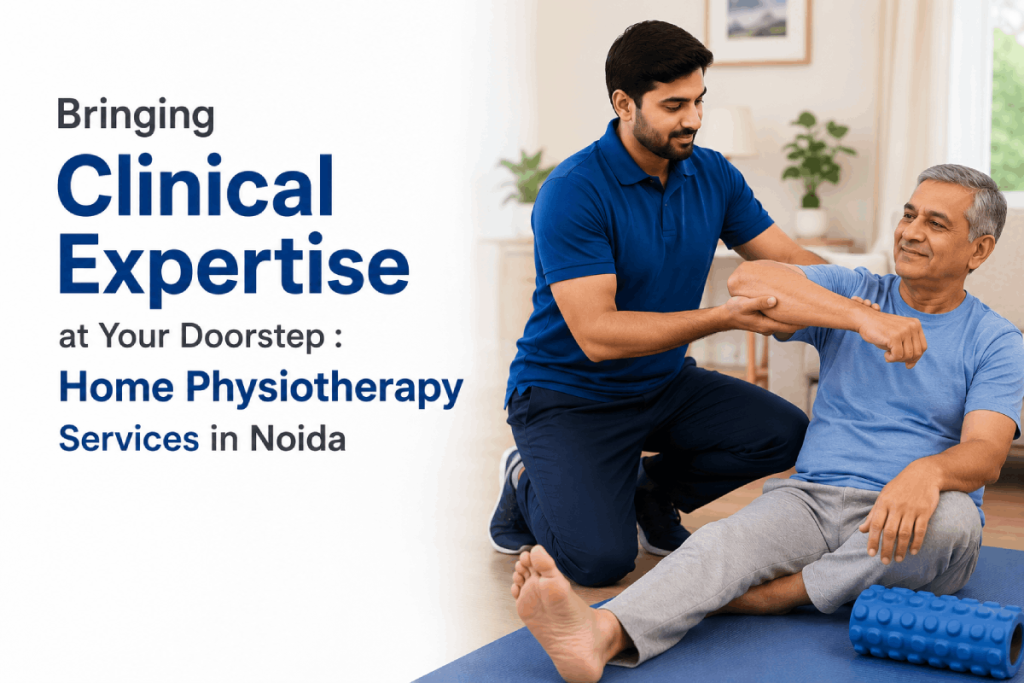
Bringing Clinical Expertise at Your Doorstep : Home Physiotherapy Services in Noida

When a patient or their family searches for doctors for home care physiotherapy, they are expressing something important: they want clinical expertise, not just physical assistance. They want a healthcare professional who will assess their condition accurately, develop an evidence-based treatment plan, and take responsibility for their recovery outcome. APRC Home Care delivers exactly that standard through a team of highly qualified homecare physiotherapy doctors whose clinical credentials and home-visit capabilities place them among the best in Delhi NCR. The term ‘physiotherapist at home’ encompasses a wide spectrum of providers, from informally trained attendants to Masters-qualified clinical specialists. Understanding where APRC’s team sits on that spectrum and why it matters for patient outcomes  is the purpose of this blog. The Qualifications Behind APRC’s Home Physiotherapy Team Every physiotherapist deployed by APRC holds at minimum a Bachelor of Physiotherapy (BPT) degree from an accredited institution, is registered with the Rehabilitation Council of India (RCI), and has completed a minimum of five years of post-qualification clinical practice. Many team members hold postgraduate qualifications in specialist areas such as orthopaedics, neurology, sports physiotherapy, and geriatric care. Prior to deployment, every physiotherapist undergoes police background verification, identity verification, and a structured clinical competency assessment. References from previous employers are verified. This rigour protects patients — particularly elderly and vulnerable patients — and ensures that every home visit is conducted by a professional who can be trusted with complete confidence. Homecare Physiotherapy Doctors in Noida: A Specific Need Met Noida and its satellite areas Indirapuram, Vaishali, Ghaziabad, Greater Noida West — have experienced explosive population growth over the past decade, creating a large and underserved demand for quality home healthcare. Homecare physiotherapy doctors in Noida through APRC are available across sectors 1 through 168 and all major residential townships. Same-day appointments are available in most areas. Noida’s demographic profile a high concentration of IT professionals, large elderly populations in established sectors, and numerous housing societies with post-surgical and neurological patients maps precisely onto APRC’s service strengths. The care team has become a familiar and trusted presence in hundreds of households across the region. Home Visit Physiotherapy for Complex Conditions Home visit physiotherapy at APRC is not limited to straightforward musculoskeletal presentations. The team is equipped and trained to manage complex, multi-comorbidity cases that require coordinated care: In all these scenarios, APRC’s physiotherapists communicate actively with the patient’s GP, neurologist, or orthopaedic surgeon — functioning as part of a coordinated care team rather than as an isolated service. The APRC Care Model: How Home Physiotherapy Actually Works Step one is simple: a phone call to +91-8882806090 or a booking through the website. The care coordinator takes a brief clinical history, identifies the most appropriate specialist from the team, and confirms an appointment within the patient’s preferred time window. The first home visit begins with a comprehensive assessment. A treatment plan with specific goals, timelines, and outcome measures is then discussed with the patient and their family. Sessions are scheduled at the frequency appropriate to the condition — typically two to three times per week in the early stages, reducing as independence increases. Progress is tracked at every session. Written reports are provided to patients at regular intervals and made available to the referring doctor on request. The full details of the booking process and care model are available online. What Patients and Families Say About APRC’s Homecare Physiotherapy Doctors After my knee replacement in Noida Sector 49, APRC’s physiotherapist was at my home within forty-eight hours of discharge. He was punctual, professional, and genuinely encouraging. Within six weeks I was walking without a stick which my surgeon said was remarkable.’ Patient, Noida Sector 49 ‘My mother had a stroke in December. APRC’s neuro physiotherapy team came every morning for four months. The therapist built such a relationship with her that Maa would be excited for sessions. She can now walk independently to the kitchen.’ Family member, Vaishali, Ghaziabad ▶  Connect with an APRC Home Physiotherapist Today  ◀ The Future of Physiotherapy at Home in Delhi NCR The demand for physiotherapist at home services in Delhi NCR is projected to grow significantly over the next decade, driven by an ageing population, rising sports participation, increasing lifestyle disease burden, and growing awareness of physiotherapy’s role in comprehensive healthcare. APRC Home Care is investing in this future: expanding its team, broadening its coverage area, enhancing its equipment capability, and deepening its specialist expertise. For patients and families who need the best home care physiotherapy Delhi NCR has to offer, APRC is not merely an option — it is the standard.

, , , ,

Bringing Clinical Expertise at Your Doorstep : Home Physiotherapy Services in Noida Read Post »

at-home sports injury clinic
Physiotherapy

Home Physiotherapy for Recovery and Rehabilitation of Leg Injury

The modern athlete — whether competing at the national level or simply pursuing personal fitness goals — faces a rehabilitative challenge that the healthcare system is often poorly equipped to meet: how do you return to peak performance, not merely to ‘functional’ capacity, after a sports injury? APRC Home Care’s specialist sports physiotherapists are answering that question for athletes and fitness enthusiasts across Delhi NCR, using advanced physiotherapy rehab protocols delivered through an at-home sports injury clinic service that meets the athlete wherever they are. This blog explores the science of sports rehabilitation, the specific demands of leg physiotherapy at home, and why APRC’s approach consistently produces athletes who return to sport not merely healed, but performing better than before their injury. The Science Behind Effective Physiotherapy Rehab Recovery from a sports injury is not a linear process of waiting for tissues to heal. It is an active, progressive biological intervention. The body heals in predictable stages — haemostasis and inflammation, proliferation, and remodelling — and each stage responds differently to mechanical loading. Modern sports physiotherapy rehab is built on the principle of mechanotherapy: applying the right amount of load, in the right direction, at the right time, to stimulate optimal tissue remodelling. Too little load produces weak, poorly organised scar tissue. Too much load causes re-injury. APRC’s sports physiotherapists are experts in calibrating this therapeutic window across every stage of recovery. Leg Injuries: Why They Demand Specialist Attention Lower limb injuries account for over 65% of all sports injuries in team and individual sports. The biomechanical demands of running, jumping, cutting, kicking, and landing place extraordinary repetitive stress on the legs, and the consequences of inadequately rehabilitated leg injuries are severe: altered running mechanics, compensatory movement patterns, and dramatically elevated risk of secondary injuries at adjacent joints. Leg physiotherapy at home addresses this risk by ensuring that rehabilitation is not just about the injured structure but about the entire lower-limb kinetic chain — from the lumbar spine and hip through the knee and ankle to the foot. APRC therapists assess and treat the whole chain, not just the symptomatic area. Specific Leg Injury Rehabilitation Programmes at APRC Hamstring Strain Rehabilitation Hamstring injuries are the most common soft tissue injury in running-based sports, and re-injury rates are notoriously high when rehabilitation is inadequate. APRC’s programme follows the evidence-based Oslo Protocol, incorporating progressive eccentric loading (Nordic hamstring curls), sprint-speed work, and return-to-sport criteria including isokinetic strength symmetry. Achilles Tendinopathy Management Achilles tendinopathy is one of the most challenging sporting overuse injuries to rehabilitate. APRC’s heavy slow-resistance protocol, delivered through leg physiotherapy at home, progressively loads the tendon through its full range of motion, stimulating collagen synthesis and tendon remodelling. Patients typically see significant pain reduction within four to six weeks. ACL Post-Surgical Rehabilitation ACL reconstruction is one of the most psychologically and physically demanding rehabilitation journeys in sports medicine. APRC’s programme spans nine to twelve months and follows internationally validated criteria-based progressions. Athletes are not advanced to the next phase until they demonstrate objective readiness — not simply because sufficient time has passed. Shin Splints (MTSS) Recovery Medial tibial stress syndrome is among the most common complaints in running athletes. APRC’s management combines load modification, progressive running reintroduction, tibial stress monitoring, footwear assessment, and hip strengthening to address the biomechanical drivers of the condition. Beyond Recovery: Performance Physiotherapy High-performance athletes increasingly engage physiotherapy rehab not in response to injury but as a proactive performance tool. APRC offers comprehensive movement screening, force-velocity profiling (where equipment allows), and sport-specific conditioning programmes that identify and correct the physical limitations constraining performance. For the corporate athlete — the executive who runs, swims, cycles, or lifts as a core part of their identity — these performance physiotherapy services provide the same quality of input that professional athletes receive, packaged for a demanding schedule and delivered at home. ▶  Talk to a Sports Physiotherapist Today  ◀ The Mental Side of Recovery No serious discussion of sports rehabilitation is complete without addressing the psychological dimension. Kinesiophobia — fear of movement and re-injury — is a clinically recognised condition that affects a significant proportion of athletes following serious injuries, particularly ACL tears and stress fractures. It is also one of the most powerful predictors of failed return to sport. APRC’s sports physiotherapists are trained to identify and address kinesiophobia through graded exposure, pain education, and confidence-building progressions. The goal is not simply a pain-free athlete — it is a confident, resilient athlete who trusts their body to perform at full capacity. Whether competing in a local cricket league or representing an institution nationally, every athlete deserves rehabilitation that matches their ambition. APRC Home Care delivers that standard across Delhi NCR, in the athlete’s chosen environment, on their schedule.

, , ,

Home Physiotherapy for Recovery and Rehabilitation of Leg Injury Read Post »

Physiotherapy

Why Waiting Makes Neck Pain Worse

Struggling with neck pain? Discover how Physiotherapy at Home for Neck Pain in Delhi NCR helps relieve stiffness, improve posture, and speed recovery without clinic visits.

, , , , , , , , , , , , , , , , , , , , , , , ,

Why Waiting Makes Neck Pain Worse Read Post »

+91 8882806090
WhatsApp WhatsApp us
Scroll to Top