
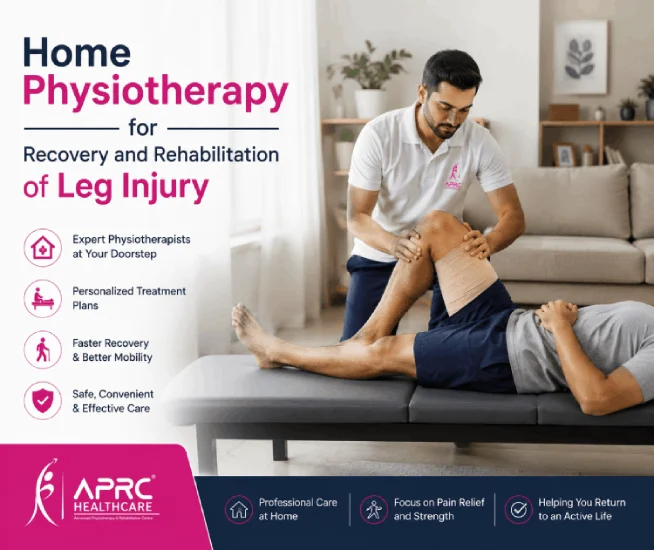
The modern athlete — whether competing at the national level or simply pursuing personal fitness goals — faces a rehabilitative challenge that the healthcare system is often poorly equipped to meet: how do you return to peak performance, not merely to ‘functional’ capacity, after a sports injury? APRC Home Care’s specialist sports physiotherapists are answering that question for athletes and fitness enthusiasts across Delhi NCR, using advanced physiotherapy rehab protocols delivered through an at-home sports injury clinic service that meets the athlete wherever they are.
This blog explores the science of sports rehabilitation, the specific demands of leg physiotherapy at home, and why APRC’s approach consistently produces athletes who return to sport not merely healed, but performing better than before their injury.
The Science Behind Effective Physiotherapy Rehab
Recovery from a sports injury is not a linear process of waiting for tissues to heal. It is an active, progressive biological intervention. The body heals in predictable stages — haemostasis and inflammation, proliferation, and remodelling — and each stage responds differently to mechanical loading.
Modern sports physiotherapy rehab is built on the principle of mechanotherapy: applying the right amount of load, in the right direction, at the right time, to stimulate optimal tissue remodelling. Too little load produces weak, poorly organised scar tissue. Too much load causes re-injury. APRC’s sports physiotherapists are experts in calibrating this therapeutic window across every stage of recovery.
Leg Injuries: Why They Demand Specialist Attention
Lower limb injuries account for over 65% of all sports injuries in team and individual sports. The biomechanical demands of running, jumping, cutting, kicking, and landing place extraordinary repetitive stress on the legs, and the consequences of inadequately rehabilitated leg injuries are severe: altered running mechanics, compensatory movement patterns, and dramatically elevated risk of secondary injuries at adjacent joints.
Leg physiotherapy at home addresses this risk by ensuring that rehabilitation is not just about the injured structure but about the entire lower-limb kinetic chain — from the lumbar spine and hip through the knee and ankle to the foot. APRC therapists assess and treat the whole chain, not just the symptomatic area.
Specific Leg Injury Rehabilitation Programmes at APRC
Hamstring Strain Rehabilitation
Hamstring injuries are the most common soft tissue injury in running-based sports, and re-injury rates are notoriously high when rehabilitation is inadequate. APRC’s programme follows the evidence-based Oslo Protocol, incorporating progressive eccentric loading (Nordic hamstring curls), sprint-speed work, and return-to-sport criteria including isokinetic strength symmetry.
Achilles Tendinopathy Management
Achilles tendinopathy is one of the most challenging sporting overuse injuries to rehabilitate. APRC’s heavy slow-resistance protocol, delivered through leg physiotherapy at home, progressively loads the tendon through its full range of motion, stimulating collagen synthesis and tendon remodelling. Patients typically see significant pain reduction within four to six weeks.
ACL Post-Surgical Rehabilitation
ACL reconstruction is one of the most psychologically and physically demanding rehabilitation journeys in sports medicine. APRC’s programme spans nine to twelve months and follows internationally validated criteria-based progressions. Athletes are not advanced to the next phase until they demonstrate objective readiness — not simply because sufficient time has passed.
Shin Splints (MTSS) Recovery
Medial tibial stress syndrome is among the most common complaints in running athletes. APRC’s management combines load modification, progressive running reintroduction, tibial stress monitoring, footwear assessment, and hip strengthening to address the biomechanical drivers of the condition.
Beyond Recovery: Performance Physiotherapy
High-performance athletes increasingly engage physiotherapy rehab not in response to injury but as a proactive performance tool. APRC offers comprehensive movement screening, force-velocity profiling (where equipment allows), and sport-specific conditioning programmes that identify and correct the physical limitations constraining performance.
For the corporate athlete — the executive who runs, swims, cycles, or lifts as a core part of their identity — these performance physiotherapy services provide the same quality of input that professional athletes receive, packaged for a demanding schedule and delivered at home.
▶ Talk to a Sports Physiotherapist Today ◀
The Mental Side of Recovery
No serious discussion of sports rehabilitation is complete without addressing the psychological dimension. Kinesiophobia — fear of movement and re-injury — is a clinically recognised condition that affects a significant proportion of athletes following serious injuries, particularly ACL tears and stress fractures. It is also one of the most powerful predictors of failed return to sport.
APRC’s sports physiotherapists are trained to identify and address kinesiophobia through graded exposure, pain education, and confidence-building progressions. The goal is not simply a pain-free athlete — it is a confident, resilient athlete who trusts their body to perform at full capacity.
Whether competing in a local cricket league or representing an institution nationally, every athlete deserves rehabilitation that matches their ambition. APRC Home Care delivers that standard across Delhi NCR, in the athlete’s chosen environment, on their schedule.