
APRC Home Care

Physiotherapy at Home for Knee Pain

Greater Noida Physiotherapy at home
Physiotherapy

Personalised Home Physiotherapy for Pain Relief and Rehabilitation

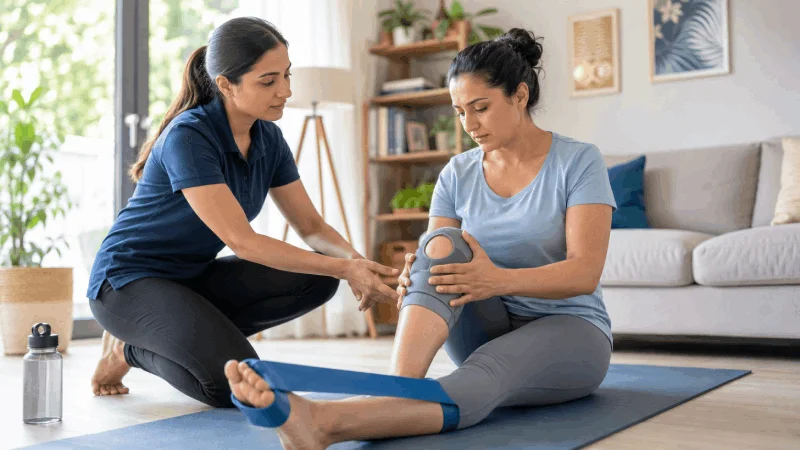
Persistent pain is difficult enough without the added strain of travelling to a clinic. For people looking for Greater Noida Physiotherapy at home, home-based care can make regular treatment more convenient and comfortable. Rushed appointments, rigid timings and uncertainty about a therapist’s credentials can sometimes lead to missed sessions and slow progress. This article explains how physiotherapy at home can help with shoulder pain, back pain, knee pain and neck pain, while also supporting sports injury recovery, post-surgery rehabilitation and elderly care.  Why Physiotherapy at Home Supports Steady Recovery Recovery depends on regular, well-guided treatment. When each session requires a commute, consistency is the first casualty, and family members often carry the burden of transport and scheduling. Home visits ease these concerns: Consistent treatment, in turn, supports faster recovery. Shoulder Pain: Physiotherapy at Home for Shoulder Pain Shoulder pain has several possible causes. Frozen shoulder most often affects adults between 40 and 60, particularly women, and people with diabetes or thyroid conditions face higher risk. Rotator cuff problems and shoulder impingement can feel similar, which is why a proper assessment matters before exercises begin. Physiotherapy at home for shoulder pain typically includes gentle mobility work such as pendulum exercises, followed by progressive strengthening. Those recovering from shoulder injury, surgery or long immobilisation benefit from a pace set by the therapist. Homemakers and desk workers can also be shown exercises that fit into the day. Back Pain: Physiotherapy at Home for Back Pain Back pain reaches a broad group, from IT professionals, drivers and delivery workers to homemakers, manual labourers and gym-goers with faulty lifting posture. It may involve the lower back, upper back or conditions such as lumbar spondylosis, and chronic cases need steady attention rather than occasional visits. Physiotherapy at home for back pain begins with an assessment of posture, movement and daily habits. Lower back pain exercises, core stabilisation and ergonomic advice are then matched to the cause. Because the therapist sees the patient’s own bed, chair and workspace, recommendations are practical rather than generic. Knee Pain: Physiotherapy at Home for Knee Pain Knee pain takes different forms. Adults over 40 may have knee osteoarthritis, seniors may struggle with stairs, and younger athletes or runners may face overuse or ligament issues. Overweight individuals often need weight-friendly exercises that relieve pain without overloading the joint. Physiotherapy at home for knee pain commonly focuses on knee strengthening exercises, controlled movement and guidance for climbing stairs more comfortably. For those hoping to delay or avoid knee replacement, regular supervised sessions offer structured support in familiar surroundings. Neck Pain: Physiotherapy at Home for Neck Pain Remote workers, students and heavy smartphone and laptop users frequently develop neck pain, stiffness, headaches or arm tingling. Poor sleeping posture and long drives add to the problem, and cervical spondylosis may be involved. Physiotherapy at home for neck pain allows the therapist to observe the actual desk, chair and pillow in use. Neck pain relief exercises, posture correction and ergonomic tips can then be tailored to the real setting, which a clinic visit cannot reproduce. Sports Injury Rehabilitation at Home Cricketers, runners, gym-goers and weekend fitness enthusiasts may need structured rehabilitation after strains, ligament injuries or tennis elbow. Home sessions support a gradual, supervised return to activity. Parents of student athletes, coaches and academies also value the flexibility, as sessions can be scheduled around training and school. Post-Surgery Rehabilitation at Home Recovery after total knee replacement, hip replacement, fracture repair or spine surgery requires steady, supervised effort during a vulnerable period. Post-operative physiotherapy at home spares patients difficult journeys and keeps family members informed about progress. Referrals from orthopaedic surgeons and hospitals are welcomed, and the treatment plan can be shared with the referring doctor on request. Elderly Care Physiotherapy at Home Adults aged 60 and above often face weakness, stiff joints and unsteady balance. Adult children arranging care for a parent, often searching on their behalf, need a dependable and practical option. Home sessions can include: Caregivers also benefit, since the need to arrange and accompany clinic visits is removed. Begin Recovery in the Comfort of Home Pain and reduced mobility need not mean inconsistent care or exhausting travel. Families can arrange an initial consultation with APRC Home Care to discuss the patient’s condition, goals and preferred schedule. Book a home visit today at aprchomecare.com and start a recovery plan that fits comfortably into daily life.

, , , , , ,

Personalised Home Physiotherapy for Pain Relief and Rehabilitation Read Post »
physiotherapy at home for knee pain
Physiotherapy

Noida Physiotherapist for muscle and joint Pain: Who to Call and Why It Matters

Pain that keeps interrupting daily life — a back that won’t loosen up, a neck that stiffens through the day, a knee that struggles on stairs, a shoulder that aches every time you reach for something — rarely fixes itself. It needs proper attention, and often that attention gets delayed simply because finding the right physiotherapist and sticking to regular appointments isn’t realistic for most people’s schedules. This guide breaks down the most common muscle and joint pain complaints people bring to physiotherapists in Noida, what usually causes each one, and what actually helps when treatment needs to be consistent rather than occasional. Back Pain: Usually Built Up Over Time, Not Overnight Back pain rarely appears out of nowhere. For working professionals with desk jobs, IT employees, drivers, and homemakers, it tends to build slowly — hours of sitting, a long commute, posture that quietly worsens without anyone noticing until it hurts. For someone managing a slip disc, sciatica, or spondylosis, even the drive to a clinic can aggravate the pain further, which is exactly where physiotherapy at home for back pain becomes genuinely useful rather than just convenient. Treatment typically starts with identifying the actual cause — whether it’s a herniated disc, muscle spasm, or a sports-related injury — and building a plan specifically around that, rather than running through a generic set of back exercises. Chronic back pain, in particular, tends to respond far better to consistent, personalized sessions than to occasional, rushed clinic visits squeezed between other commitments. Neck Pain: The Screen-and-Posture Problem Neck pain has become almost unavoidable for anyone spending long hours in front of a screen. Desk-based professionals, students, and remote workers between roughly 20 and 50 are the most common group affected, along with drivers and anyone who’s picked up poor posture habits over the years. The pain tends to follow a pattern — stiffness in the morning, a dull ache that builds through the day, sometimes headaches that seem unrelated until the neck loosens up. Cervical spondylosis, text neck, and whiplash from old injuries are common underlying causes, and each needs a slightly different approach. Physiotherapy at home for neck pain allows a therapist to actually observe how someone sits, works, and moves through their day — information that’s difficult to gather during a short clinic appointment. That context tends to matter more than people expect when it comes to actually resolving neck pain, rather than just easing it temporarily. Knee Pain: A Different Plan for Every Cause Knee pain covers a lot of ground. Adults over 40 dealing with arthritis or general joint wear need a different approach than someone recovering from a knee replacement or ligament surgery. Athletes and younger adults managing an ACL or meniscus injury need something different again. A few of the more common scenarios a Noida physiotherapist handles: Physiotherapy at home for knee pain is particularly useful here because consistency genuinely affects outcomes — a missed or delayed session during post-surgery recovery can set progress back in a way that’s hard to fully make up. Removing the travel barrier makes it far easier to stick to the schedule a joint actually needs to heal properly. Shoulder Pain: Often Ignored Until It Limits Daily Life Shoulder pain tends to get pushed aside longer than it should. People assume it’ll settle on its own, and sometimes it does — but for adults between 30 and 60 dealing with repetitive strain, poor posture, or age-related stiffness like frozen shoulder, it usually doesn’t. Athletes, gym-goers, and manual workers face a related but different problem: overuse or rotator cuff injuries that limit movement during everyday tasks like reaching, lifting, or even getting dressed. Shoulder impingement and dislocation recovery both need careful, progressive treatment — rushing this tends to cause setbacks rather than faster results. Physiotherapy at home for shoulder pain allows treatment to be paced properly, with a therapist tracking exactly how range of motion is improving week to week, rather than relying on the patient’s own memory of how things have changed since the last clinic visit. Why Muscle and Joint Pain Responds Better to Home-Based Treatment Across back, neck, knee, and shoulder pain, a few problems show up again and again — difficulty traveling comfortably while in pain, inconsistent treatment caused by missed or rushed appointments, and uncertainty about whether a therapist is actually qualified for the specific condition. A home-based approach in Noida addresses these directly: For families coordinating care around a parent’s knee surgery or a partner’s chronic back pain, this also removes a real logistical burden — no arranging transport, no rearranging work schedules around a single appointment. Getting Started with the Right Treatment Plan Whichever pain is the actual problem — muscle-related or joint-related, back, neck, knee, or shoulder — the path forward starts with an accurate assessment and a plan built specifically around it, not a one-size-fits-all approach. Consistency matters as much as the treatment itself, and that’s often easier to maintain when travel isn’t part of the equation. The next step is a conversation with a qualified Noida physiotherapist about the specific pain, and what a personalized, home-based plan would actually look like.

, , ,

Noida Physiotherapist for muscle and joint Pain: Who to Call and Why It Matters Read Post »

physiotherapy at home for knee pain
Physiotherapy

Is Physiotherapy at Home Worth It for Knee Pain?

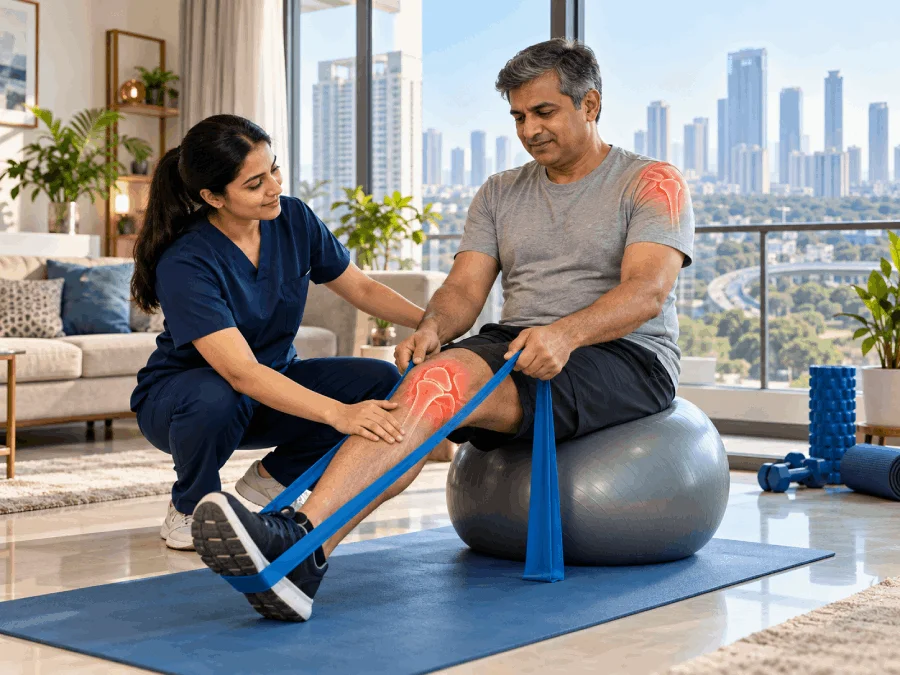
Knee pain has a way of quietly reshaping a routine — skipping the stairs when possible, avoiding certain movements during a workout, or rescheduling a trip because sitting through a long flight feels daunting. Before committing to a treatment plan, it’s fair to ask whether physiotherapy at home for knee pain actually delivers, or whether it’s simply a more convenient version of the same clinic experience. This article looks at what physiotherapy at home for knee pain actually involves, how it compares to clinic-based care, and what factors should inform the decision — so it can be made with clarity rather than assumption. What “Worth It” Actually Means Here For a patient evaluating treatment options, “worth it” usually comes down to three practical questions: Will it be consistent enough to work? Does it fit realistically into an existing schedule? And does the format allow the therapist to actually understand the problem, not just treat a symptom in isolation? Physiotherapy at home for knee pain is often evaluated against these same questions — not against a vague standard of “better” or “worse” than a clinic, but against what actually supports a full recovery. How Home-Based Treatment Differs From Clinic Visits The core physiotherapy techniques — targeted exercises, manual therapy, mobility work — are largely consistent whether delivered at home or in a clinic. What differs is the context and the logistics surrounding treatment. A home-based therapist observes how a patient actually moves through their own environment: navigating stairs, getting up from a favorite chair, or walking across an uneven driveway. This kind of real-world context can shape treatment in ways a generic clinic session might not capture. A Practical Scenario Consider someone recovering from a knee procedure who travels frequently and works long hours. Committing to twice-weekly clinic visits means factoring in travel time and rescheduling around an already packed calendar — and missed sessions can slow recovery meaningfully. A home-based approach removes that friction, allowing treatment to continue on schedule rather than being pushed aside during a busy week. What a Typical Session Involves A home physiotherapy session for knee pain generally includes an assessment of current mobility and pain levels, targeted strengthening and range-of-motion exercises, and practical guidance — such as how to manage stairs safely or adjust activity levels day to day. Sessions typically build progressively, adjusting based on how the knee responds over time. Weighing the Cost Consideration Physiotherapy at home cost is a natural part of this decision, and it varies depending on session frequency, treatment complexity, and location — physiotherapy at home in Delhi, for instance, may be priced differently depending on the provider and specific treatment plan. Rather than assuming home-based care is automatically more expensive than clinic visits, it’s worth requesting a clear breakdown directly from a provider, since pricing structures differ. When Home-Based Physiotherapy Tends to Make the Most Sense Home-based care tends to be a strong fit when: It may be less suited to cases requiring specialized clinical equipment not practical to bring into a home setting — a detail worth discussing directly with a therapist before starting treatment. Beyond Knee Pain: A Broader Model of Care The same home-based approach extends to other needs as well. Patients searching for physiotherapy at home back pain, a physiotherapist home service near me, or physio at home near me will typically find a similar model — treatment built around the patient’s actual environment and schedule. This also applies to more specialized care, including neuro physiotherapy at home for patients managing neurological conditions, where consistency and a familiar setting — supported by a dedicated neuro physiotherapist near me — often play a meaningful role in the recovery process. Making the Decision Ultimately, whether physiotherapy at home for knee pain is “worth it” depends less on the treatment techniques themselves — which are broadly similar to clinic-based care — and more on which format a patient will actually follow through with consistently. For many patients balancing demanding schedules, the reduced friction of home-based care is what turns a treatment plan from theoretical to actionable. For those weighing this decision, APRC Home Care offers physiotherapy at home for knee pain, along with related services such as neuro physiotherapy at home, built around each patient’s schedule and recovery needs. Learn more or book a consultation at https://aprchomecare.com/.

, , , ,

Is Physiotherapy at Home Worth It for Knee Pain? Read Post »

physiotherapy at home for knee pain
Physiotherapy

Physiotherapy for Knee Pain at Home with APRC Home Care

Get expert physiotherapy at home for knee pain with APRC Home Care. Personalised treatment, faster recovery, and safe care for elderly & post-surgery patients.

, , , , , , , , , ,

Physiotherapy for Knee Pain at Home with APRC Home Care Read Post »

+91 8055815581
WhatsApp WhatsApp us
Scroll to Top